Dropshipping or print on demand: which first?
A plain comparison of dropshipping and print on demand for a first online store: what you control, where the money goes and how long each takes to launch.
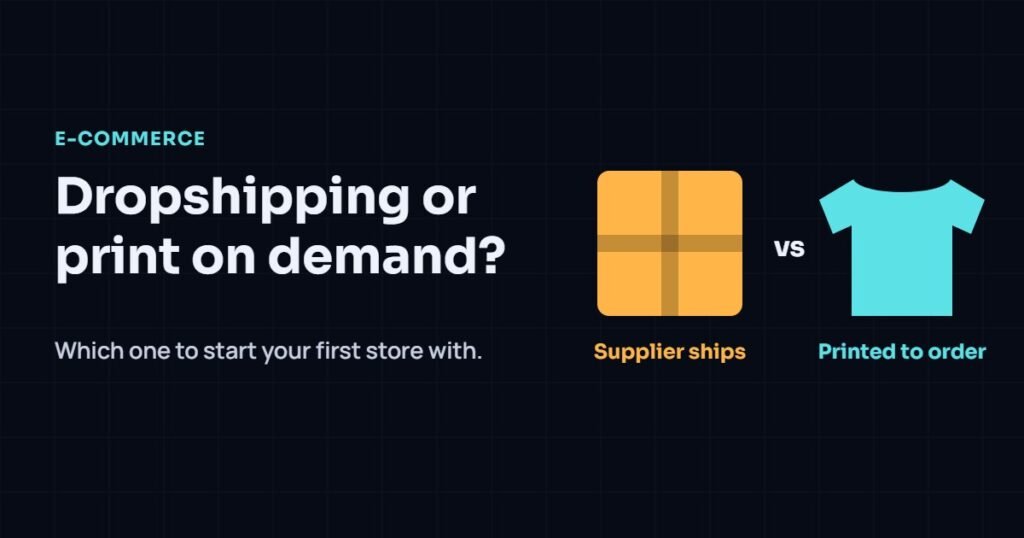
Both models let you sell products you never keep in stock. What differs is who creates the product. That one difference changes your costs, your delivery times, your risks and the way you find customers, so it is worth settling before you build a store.
Both sell products you never keep in stock. What changes is who creates the product.
*Invented round numbers to show the arithmetic. Your real costs come from your supplier’s or print partner’s price list.
How each model works
With dropshipping you list products that a supplier already makes. When a customer orders, the supplier packs and ships it to them. You choose the products, set the price and run the store and the marketing.
With print on demand you supply the design. A print partner such as Printify, Printful, Gelato, Qikink or Printrove prints it on a shirt, mug, poster or similar item only after someone orders, then ships it. The product is yours because the design is yours.
What you control
Dropshipping gives you a wide choice of products quickly, and you can test an idea without making anything. You do not control quality or stock. If the supplier runs out or changes the item, your listing is wrong until you notice.
Print on demand gives you a brand. Nobody else sells your design, so you are not competing on price against the same photo on ten other stores. You control the artwork but not the printing, so quality depends on the partner you choose. Order a sample of every product before you sell it.
Where the money goes
The numbers below are invented round figures to show the arithmetic. Your real costs come from your supplier’s or print partner’s price list.
A dropshipped item sells for $30. The supplier charges $14 for the item and $5 for shipping. Payment fees and platform costs take about $1.50. That leaves $9.50 before advertising.
A printed T-shirt sells for $28. The print partner charges $15 including shipping, and fees take $1.50. That leaves $11.50 before advertising.
Now add ads. If it costs $12 in advertising to win one customer, both stores lose money on that first order. What matters is the gap between your margin and the cost of winning a customer. A product that leaves $9.50 only works if you can win customers for less than that, or if buyers come back.
How long each takes to launch
These are our own timelines for the work we do. A template dropshipping store takes 7 to 10 business days. A custom store or business website takes 3 to 8 weeks. A print-on-demand design collection takes 1 to 3 weeks. Each timeline starts once we have payment and the content we need from you, and your proposal lists the exact dates.
Shipping and returns
In both models the supplier or print partner ships the order, so delivery time is theirs. It varies by country, and some markets, including the Gulf and parts of Asia, can take longer. Look up production and delivery times for each country you plan to sell in, and put them on the product page. Customers accept a long delivery time that you stated up front. They do not accept one they found out about after paying.
Decide your return policy before launch, and check what your supplier or print partner will take back. Many print partners only replace items that arrive damaged or misprinted, so check before you promise more.
The risks of each
Dropshipping risks include stock-outs, price changes, uneven quality and customers who blame you for a supplier’s delay. It is also easy to copy, since anyone can list the same product.
Print on demand has thin margins on each item, and designs that copy someone else’s trademark or artwork can get your store taken down. Sell only designs you own or have a licence for. A famous character or a brand name on a shirt is the usual cause.
Which one to start with
Start with print on demand if you can design, or you know a specific audience well, such as a hobby, a profession or a local culture, and you want a brand that is yours. Expect slower early sales and a smaller catalogue.
Start with dropshipping if you already know a product type that sells, you have a budget to test ads, and you are comfortable monitoring suppliers. Expect more competition and more day-to-day checking.
If you have neither a design skill nor an ad budget, wait. Both models need either creative work or advertising money, and a store with neither mostly sits idle.
Questions to answer before you build
- Which countries will you sell to, and how long does your supplier or print partner take to deliver there?
- What is the margin per order after the item, shipping and fees?
- How much can you spend to win one customer without losing money?
- Who owns the designs or the product photos?
- What happens when a customer asks for a refund?
We build both kinds of store: see dropshipping stores and print on demand stores. When the store is ready, our guide to choosing between Meta and Google ads covers the next decision, and the paid ads page explains how we run campaigns.